
Questioning Theory Over Practice
An analysis about Hegel’s philosophy

Hegel’s philosophy is something I understand now, and I can identify thoughts and ideas.
He believed in something he called “Geist” or spirit if we take it to English. This also works in Spanish or other languages, I believe. Quite interesting, actually.
I actually believe in what he proposed; however, I have some opinions about it.
He divided architecture in 3 periods: symbolic. classical and romantic.
In the first one, we travel to ancient Egypt, we go to the pyramids, and he thought that this spirit is something that goes beyond, something that connects us as people, feelings, not just materials or structures.
Something I agree with is that in that epoch, everything was truly connected with the earth, because it is not fully developed, not ornamental, it just exists. If we take the pyramids as an example, they are huge, imposing structures. and he believed they weren’t beautiful.
Here’s my take: maybe when it comes to the visual, he didn’t find them “beautiful”, but, the way I see it, in the present time, we believe they are beautiful indeed, and as I mentioned, imposing. I believe that more than structures, they serve to remind us of a distant past, respect for a culture, respect to death and to the kings that ruled a long time ago, and that remains today. And that’s why I believe they are beautiful.
Maybe there’s where the concept of spirit might come in; because it’s the way a feeling or sensation connects millions of people around the world when it comes to the pyramids.
I wonder how you feel about this. It’s interesting, isn’t it?
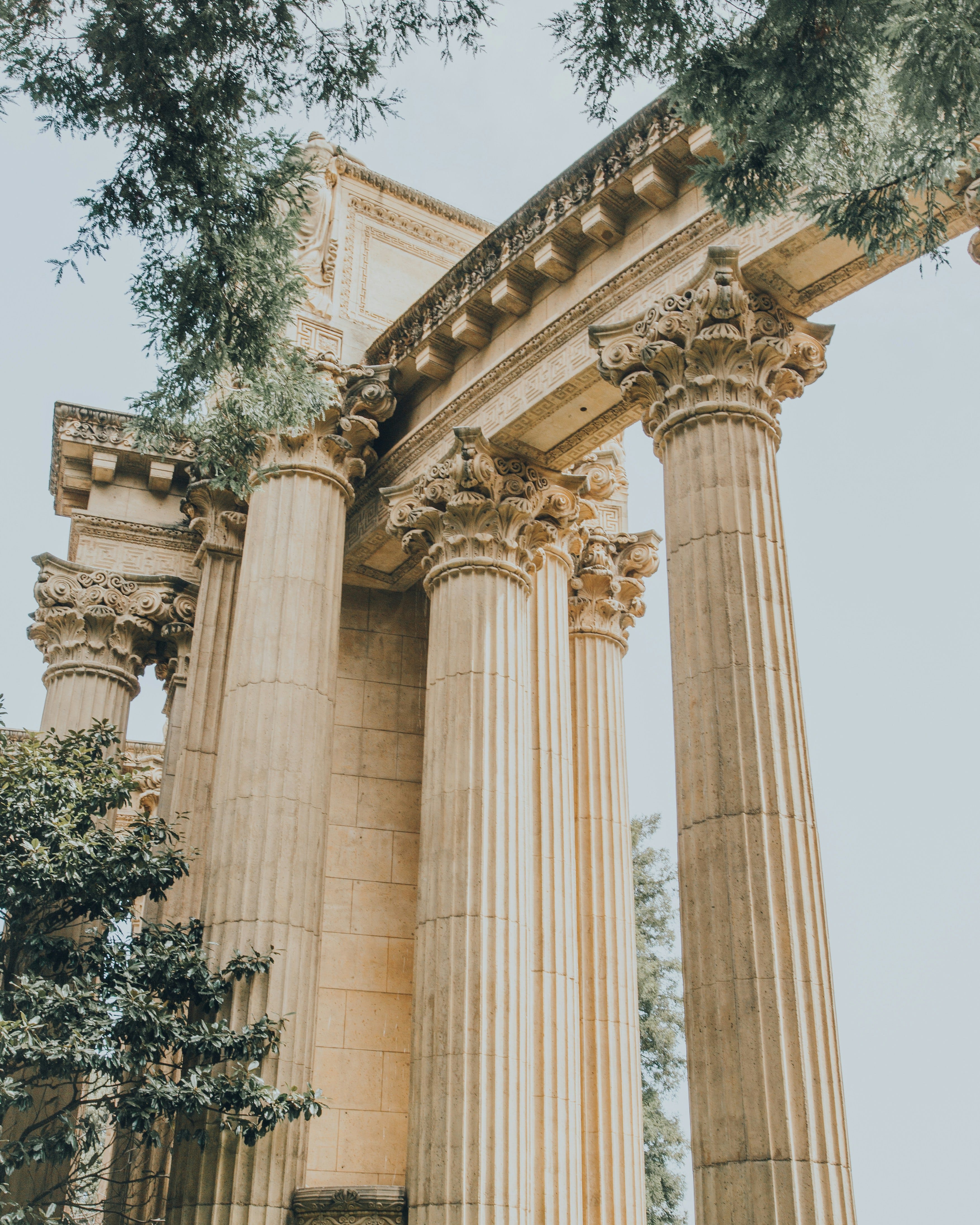
Now, our journey takes us to ancient Greece, where the temples surround our vision, where the gods from the Olympus receive us. And we stop to think and to feel, to truly look up. something that we don’t usually do in real life.
I believe this is a tour through a few eras and feelings. Questioning everything and thinking not only about structures, but feelings.
In this period, Hegel talked about classical architecture, the middle of everything. He believed this was a fusion between forms and function. I actually remember Alberti and the columns.
This is where everything takes form. Here the spirit is fully conscious. Connected. The stone is still rooted to earth, but with a form, a feeling, a sensation. Where the gods were praised. This is not necessarily religious. But something with a soul. With intention.
Here, we have columns, the Classical Orders: Doric, Ionic and Corinthian; even the Romans adopted these Greek orders and used them as decorative elements more than a strict structural system; like Tuscan Doric and Composite columns.
I believe that’s why Hegel said this was the full concept of beauty. Interesting.
But this is not the end. This tour goes now to the gothic cathedrals; To a romantic period. Here everything is deeper, intricate, complicated when it comes to architecture and forms and structures.
While Hegel believed that the spirit was diluted because of this kind of construction, I think the following:
In this gothic period, everything was used to scare people, to make them believe they were inferior, useless, unless they believed. This architecture was considered by Hegel as excessive, in my own words, of course; but I tend to analyze and go deeper.
Let me take you to Thailand and to a different period. Let’s explore Wat Arun or the Temple of Dawn; here we have a complicated structure, but at the same time, relaxing, inviting you to connect with yourself, to stop thinking, to breathe and to believe that no matter what you’re going through, there’s hope, and the light will always illuminate your life, your thoughts, your pieces or fragments.
This is the opposite to the gothic. Where everything is deeper and scary.
Here, at Wat Arun, the architecture is different, rooted, deep and introspective.
So how do we connect all of this?
Hegel’s final thought was that everything was evolving into something abstract, where the spirit wasn’t present at all, and I actually don’t differ, but then again, I have my own opinions.
He talked about the end of art. However, maybe the spirit, or this connection to the world, the earth, the structures, never left, but evolved into something deeper, different. Because maybe each person has their own opinion, their way to see life through their own lens, their own passion and feeling.
Architecture is evolving with time, with experiences, it doesn’t lose its soul when it becomes complex, ornamental, or emotional. It loses it when we stop paying attention. When we stop asking how a space makes us feel, or why a structure exists the way it does.
To me, everything is deeply rooted; the need to connect, to believe, to remember, the way we think, the way we feel. When we start to pay attention to our surroundings. Sometimes architecture goes beyond complicated or abstract structures.
Today, it doesn’t move in a single direction. It adapts, it evolves; just like us. Always changing, always questioning life itself.
This is not a finished concept, but as an ongoing conversation between space, history, and human experience.